The Line
Breaking the Cross
The lost sheep of Israel, the road to Kashmir, and the royal house of Kashmir and Judah.
From “Breaking the Cross: The End of Christianity as we know it” by Mo Ansar, first published 18 September 2025.
The following article is a testimony of fact, compiled academically to a journalistic standard with proofs included. The reader is invited to do their own research in this area.
A thousand people have told this story for a thousand years and yet we have been denied it until now.
It has been prophesied that in these End Times the cross shall be broken. It has also been said that without the crucifixion and resurrection, there is no Christianity.
If it is decreed that there must be a reckoning; so be it.
Let me first say this. I love those who love Jesus and those who follow him, truly, have nothing to fear nor grieve in the next life.
When I found out who I was
When I found out who I was, my ancestry and lineage, everything changed. For me and for everyone. Everywhere.
How, you might ask?
Whilst I was born into humble beginnings, a council estate in Watford, England, just along from the football ground; there was something special about my family. Something different. And it would take me half a century to figure it all out. And figure it out, I did.
At the time of my birth, for two hundred days a comet graced our skies. As a child, I attended an English comprehensive primary school, then to the local grammar school and on to University. All that time, I had thought myself as British Asian, and accordingly ticked the relevant box on the forms. But all that was about to change.
When I read the Bible at school, I read of Jesus’ life and times. His miraculous birth. How he was also born under a celestial sign, the star of Bethlehem. Magi came from across the world, from Persia, India and Arabia, to visit him. I learned of his childhood. The miracles. And then he disappears for 17 years returning as a 29-year-old man. He preaches, does miracles, casts-out evil spirits and challenges the unrighteous attempting to bring them on to the straight path. Then the crucifixion. At age 33, the Bible says he disappears. Again.
Well, it’s finally time to fill in the gaps in the storyline of Jesus.
The lost sheep of Israel and the Old Silk Road
Aged 12, the invincible Son of Man, with his super-powers developing, decides life in Jerusalem is not for him and he wants a change. He has just finished three days and nights of lecturing in the Temple and now he is to go and find his family — the lost sheep of Israel. They are the descendants of Jacob (known as Israel) who were exiled from the Holy Lands centuries earlier. At that time, there really was only one path across this world — the Old Silk Road. It is a beautiful and mystical road that flows from Jerusalem to Kashmir where it splits into two — there is a northern route and a southern route around the Himalayas, then to China.
Jesus travels by foot and donkey, this great road. He finds his people. The tribes of Israel. He spends decades in the region — all recorded in Buddhist manuscripts written in Pali and guarded by the Dalai Lama for thousands of years. Many people find out and verify this story throughout the ages. Jesus is known as Youza Asif (‘Youza the Virtuous’). In the West, these are some of many truths which are buried deep in the mists of time. Intentionally buried. However, the funny thing about truth is that no matter what you do, you can’t beat it. Like a good curry.
The Temple at Passover
And I am assuming my great-grandfather had his fill of good curries because aged 29 years and now a fully grown man, he returns to Jerusalem. One Passover he wanders into the Temple and witnesses utter carnage. Hundreds of thousands of animals being slaughtered. Josephus said it was into the millions. Because that was what they did. That was their trade and main industry. Killing. Death. Sacrifice. And oh boy, was it lucrative.
You see, Jerusalem was a quiet little town back then with no real trade or industry to speak of. It was a holy place since the times of David and Solomon a thousand years earlier. However, come the time of year when the children of Israel needed to absolve themselves of their sins… utter bloody horrors. Imagine the scene: a thirty-year-old man standing in the middle of an amphitheatre of death, entrails and blood flowing knee-high through massive underground drainage systems. The smell. The sight. The sounds. And all for what? Because people wanted to be forgiven for their sins.
Two thousand years later we find it ridiculous. Because it is. If you have done something wrong, get on your knees, pray to God, say sorry. Right the wrong. Fix what has been broken. Compensate what needs to be compensated. And don’t do it again. Repentance and absolution is rather more simple and straightforward today. No one needs to be taking Nelly-the-Cow to get her head chopped-off and then eviscerated, dismembered and burned on an altar. That’s just silly.
The return to Kashmir
Returning to Jesus’ life story. After he upsets the meat industry and pretty much everyone in town, there was a trial and crucifixion. We do not need to get stuck in the weeds here but suffice to say, he didn’t die on the cross and then get beamed-up to heaven through a hole in a roof. Obviously.
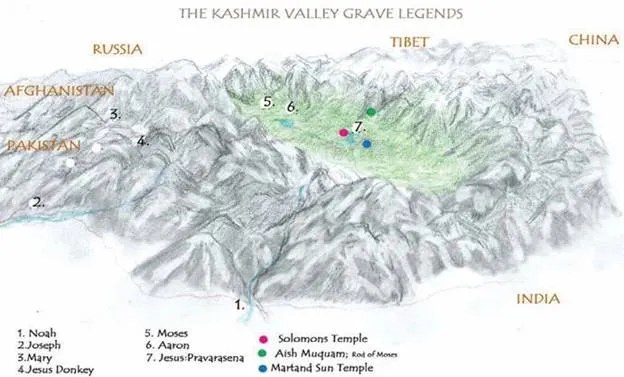
What instead happened is that before the destruction of the second temple which, no doubt he saw coming with continuing and increasing hostilities and desecrations by the Romans; he takes his mother (and apparently his brother) and they left for good. They went home. Back to the land of prophets and kings. The resting place of Noah, Moses and Aaron. The place where Solomon had visited and toured, leaving his mark.
And there, in the idyllic folds of the mountains in Kashmir they lived out their days. Jesus, like me, a prince of Judah descended from King David, had a family, a tribe. I imagine he lived a wonderful life in the green hills amongst people he loved and that loved him back. At the ripe old age of 120, he dies and is buried in Rozabal near Srinagar. His amazing mother, Mary or Maryam, my grandmother, is buried two days walk west at Pindi Point in a town named after her: Murree.
The royal house of Kashmir and Judah
The ancient royal family of Kashmir, the original rajputs of that region, are their descendants. My family.
And when the British shuffled the pack, people forgot. However, God is the best of all planners; and one day, a kid from Watford will figure it all out. He will piece together his history. And in doing so, our history.
So, as it turns out, Jesus didn’t die on the cross after all. He lived a full life. And has a grave. And is in heaven.
Christ was indeed King. He was the King of Kashmir and of the ancient royal family of Kashmir and the House of Judah. Of me, my father and my brothers.
And accordingly, I am known as Star of Jacob, the Hebrew Moshiach; the first man in my family line to ever get his ear pierced; the stump of Jesse, the branch of David and a prince of Kashmir, Judah and Jerusalem.
I am the root out of dried ground and I am on a mission.
You can call me, Mo.
The first witness
Nicolas Notovitch
In 1887 the Russian journalist and traveller Nicolas Notovitch (born 1858) journeyed through Kashmir to Ladakh on the Himalayan plateau. Laid up with a broken leg at the great monastery of Hemis, near Leh, he was read an ancient Buddhist text: the life of Saint Issa, the prophet the lamas knew as Jesus. It told of a young Issa who left Israel and spent the missing years of his life in India, Kashmir and the Himalayas, learning and teaching, before returning home.
Notovitch brought the account back to Europe. Before he published, he went to the Church. In his own words, a cardinal in Rome “very near to the Holy Father” warned him that printing it would only create enemies, and then offered him money: “If it is a question of money which concerns you, I can ask for you a reward for your notes.” In Paris, Cardinal Rotelli also urged him not to publish. Notovitch refused them both. La vie inconnue de Jésus-Christ, The Unknown Life of Jesus Christ, appeared in 1894 and was soon translated into English, German, Spanish and Italian.
He was torn apart for it. From Oxford, the great orientalist Max Müller declared him either the victim of a joke or a fabricator, and in 1895 J. Archibald Douglas, a professor in British India, travelled to Hemis to discredit him. Britain’s academic and imperial establishment closed ranks against him, and his name has been dragged through the mud ever since.
Yet others followed in his footsteps to see for themselves. In 1922 Swami Abhedananda, a direct disciple of Sri Ramakrishna and once a sceptic, went to Hemis; the lamas confirmed that Notovitch had stayed there and showed him the verses. In 1925 the explorer and artist Nicholas Roerich was shown the texts and told that Issa had lived in the Buddhist monasteries, and wrote of it in The Heart of Asia. In 1939 Elisabeth Caspari, the Swiss Montessori educator, visited Hemis and was shown the scrolls with the words: “These books say your Jesus was here.” And Paramahansa Yogananda, author of Autobiography of a Yogi, carried the account of Jesus in India to the West.
Their testimony confirms what Notovitch reported: the missing years of Jesus were spent in Kashmir and on the Himalayan plateau.
Read more
The Unknown Life of Jesus Christ (free, Project Gutenberg) · 1894 edition (Internet Archive) · Amazon UK
In tribute
Suzanne Olsson
“I could never have pieced this jigsaw puzzle together across time and space without Suzanne’s forty-year personal crusade to uncover the truth.”Mo Ansar
Suzanne Olsson was an American author, researcher and intrepid adventurer, and a graduate of New York University. Before her life’s work took hold she served ten years with the United States Postal Service, rising to Acting Postmaster in the Florida Keys, and ten years on humanitarian and refugee projects with the International Red Cross. She was in Pakistan shortly before 11 September 2001, and stayed on to help in the refugee camps.
For forty years she followed the trail of Jesus to Kashmir. She travelled through India, Pakistan and Afghanistan; she documented the Roza Bal shrine in Srinagar and the graves of the prophets in the Kashmir Valley; and she founded the DNA of God Project to seek DNA from tombs of the biblical era. She spoke at the 2009 Kashmir Peace Conference in Washington, DC, and appeared in documentaries on Jesus in India.
Suzanne passed away in 2022. Her work did not end with her. She passed the torch to Mo Ansar, who carries it on to its ultimate conclusion. A personal heroine.
Her published works
- Jesus in Kashmir: The Lost Tomb (first published 2002; revised editions 2011 and 2019)
- Roza Bal: The Tomb of Jesus, with Professor Fida Hassnain (2008)
- Jesus in Kashmir: The Roza Bal Tomb (2021)